🛍️ Add products to unlock free delivery!
Your bag is empty
Continue Shopping
4.5 / 5.0
(6) 6 total reviews
5.0 / 5.0
(3) 3 total reviews

4.75 / 5.0
(12) 12 total reviews

4.67 / 5.0
(3) 3 total reviews
4.67 / 5.0
(3) 3 total reviews
4.67 / 5.0
(3) 3 total reviews
4.67 / 5.0
(3) 3 total reviews
Quick answer: Raw ingredients for handmade soap, candle, and cosmetic formulation - includes mineral salts (Himalayan pink salt with 84+ trace minerals, Epsom salt as magnesium sulfate), dried botanicals (chamomile, calendula, marigold, jasmine) for embedding and botanical infusions, and specialty plant waxes (carnauba, candelilla) as vegan beeswax alternatives. Usage benchmarks: Himalayan pink salt in bath soaks at 2-4 tbsp per full bath; calendula petals in cold process soap at 1-2 tbsp per 500g base added at light trace; carnauba wax in lip balm at 1-3% for hardness; candelilla wax at half the quantity of the beeswax it replaces, since it is roughly twice as hard.
Raw ingredients are the starting point of everything handmade - the material choices made here determine how a finished product behaves, how long it lasts, and what can honestly be put on the label. This collection covers the base materials that appear consistently across soap making, candle making, bath product production, and cosmetic formulation: salts for mineral soaks, botanicals for texture and visual interest, and specialty waxes for clean-beauty and vegan product lines.
Himalayan Pink Salt - The characteristic pink colour comes from iron oxide and trace mineral content - 84+ minerals including magnesium, calcium, and potassium. In bath soaks the standard ratio is 2-4 tbsp per full bath for a mineral-rich soak; for salt scrubs, 2 parts salt to 1 part carrier oil is a starting point, adjusted for desired coarseness. In soap making, small grain sizes add gentle exfoliation without being abrasive. Do not use on broken skin or post-waxing.
Epsom Salt - Magnesium sulfate, not a true salt. The magnesium and sulfate compounds are well-documented for muscle relaxation in bath use. Standard bath soak: 1-2 cups per full bath, soak 15-20 minutes. Also used in salt bars (soap bars with high salt content that produce a lotion-like lather) and in garden and horticultural applications. Does not interact with the skin the same way as Himalayan salt - the mechanisms are different.
Dried Chamomile Flower - Add at light trace in cold process soap at 1-2 tbsp per 500g base. The pale yellow colour holds reasonably well through the cure in most bases. In melt and pour, press dried chamomile on top of a partially cooled pour or embed in clear glycerin base. Botanical infusions: steep chamomile in warm carrier oil (coconut or sweet almond) for 3-4 weeks to extract the mild flavonoids before adding to formulas.
Calendula Dried Flower - One of the most used botanicals in sensitive skin and baby soap formulations. The orange-yellow petals add colour and a traditional herbal aesthetic. Calendula-infused oil (petals steeped in olive or sunflower oil for 4-6 weeks) is a formulation staple for dry and sensitive skin products. In melt and pour, the petals discolour brown over time - use for short-shelf products or decoration only.
Carnauba Wax - Sourced from Brazilian palm leaves. The hardest natural wax available commercially, with a high melting point (82-86 degrees Celsius). Used in lip balms, solid perfumes, mascara, and candles as a hardener and vegan beeswax substitute. In lip balm: 1-3% for light hardness, up to 5% for a firmer stick. Above 5% creates a waxy, dragging texture that most users find unpleasant. Also used in food-grade confectionery coatings and wood polishes.
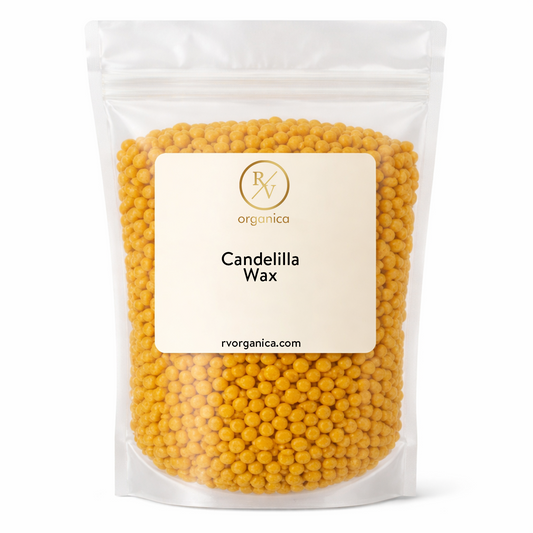
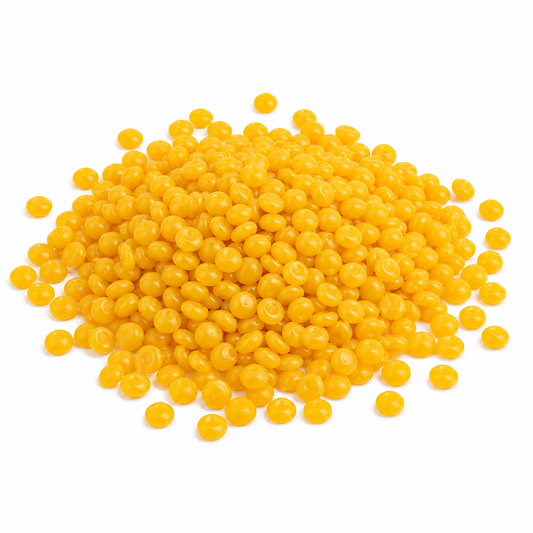
Candelilla Wax - Sourced from the candelilla shrub native to Mexico. About twice as hard as beeswax by molecular structure - when substituting for beeswax in a formula, use half the quantity to get similar hardness. Melting point 68-73 degrees Celsius, lower than carnauba. The most common vegan substitute for beeswax in lip products and hair pomades. It gives a shinier finish than carnauba and leaves a slightly more emollient feel.
Browse the complete range at rvorganica.com/collections/raw-ingredients. Bulk and wholesale quantities available for production buyers.
RV Organica supplies raw ingredients for soap, candle, and cosmetic production from its facility in Nimbri, Panipat, Haryana. Technical Data Sheets and MSDS documentation are available on request for formulation buyers. Products ship in retail and bulk quantities across India, with B2B pricing available for volume orders.