


Mithaas Gift Set for Her
Rs. 2,889.00Rs. 5,999.00New Launch
🛍️ Add products to unlock free delivery!
Your bag is empty
Continue Shopping100% Pure & Natural | Reduces Stress | Enhances Mood | Nourishes Skin (When Diluted)
Need large quantity? Contact us for bulk orders →
Couldn't load pickup availability

Patchouli Essential Oil
Rs. 949.00

Lavender Fragrance Oil
Rs. 449.00

Siberian Fir Needle Carrier Oil
Rs. 499.00
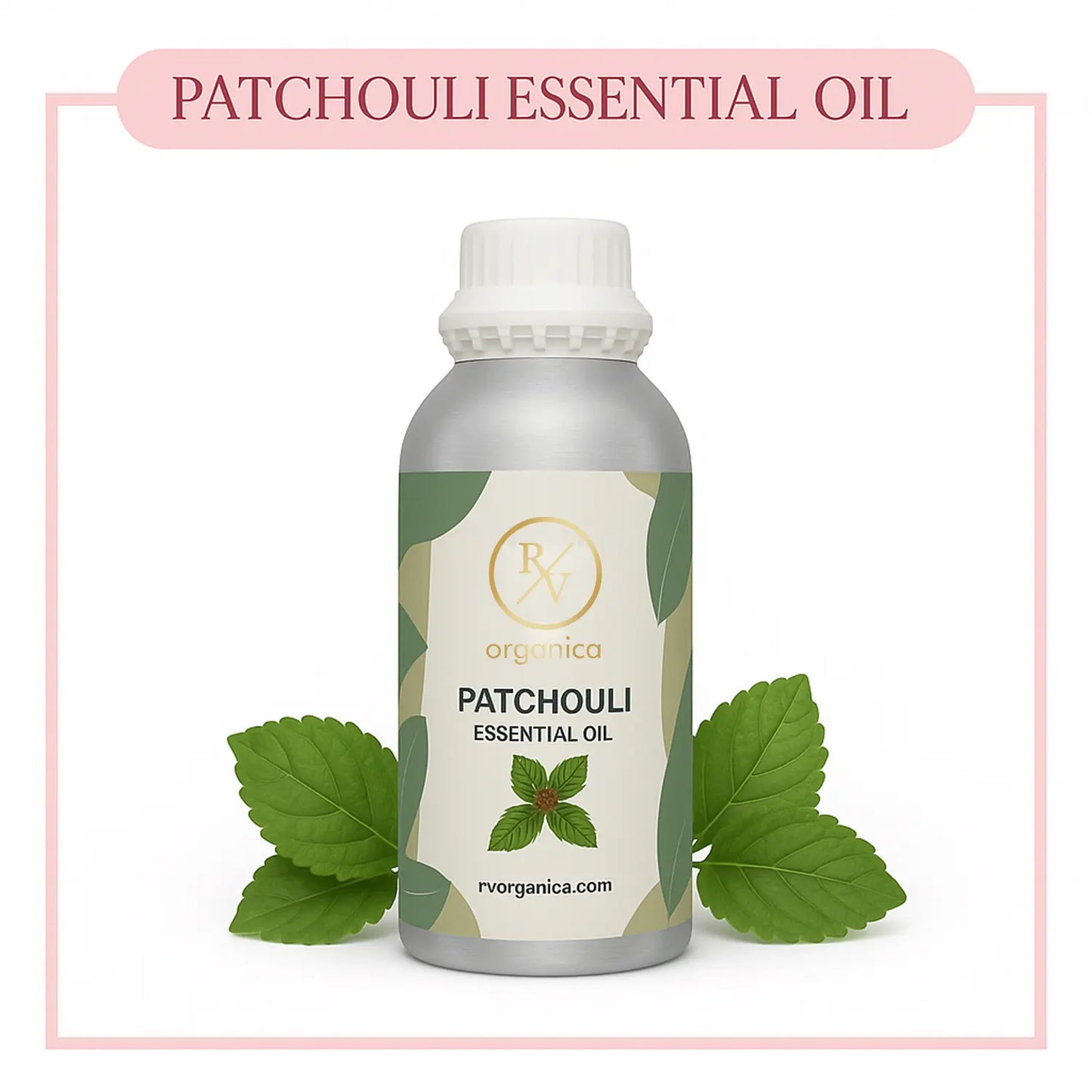


Quick answer: Patchouli Essential Oil is steam distilled from dried and fermented leaves of Pogostemon cablin and has a rich, earthy, woody, musky scent that lasts a long time. It is used as a base note in perfumes and attars, and in soaps, candles, hair oils and diffuser blends. It comes in 100 ml and 500 ml bottles for home use and 1 kg to 25 kg packs for brands and bulk buyers.
Patchouli Essential Oil is a pure plant extract with over 200 years of recorded use, named after the Hindi term "pacholi," meaning to scent. RV Organica's Patchouli Essential Oil is 100% pure patchouli oil with no artificial preservatives, no added fragrance, and no fillers, formulated for use in aromatherapy, skincare, and hair care.
Patchouli was initially used to protect stored fabrics from insects before its broader applications for skin, nerves, and mood were discovered, and the practice spread widely across Asia over the centuries that followed. Its scent is notably polarizing compared to most essential oils — earthy, rich, and almost burnt-beige in character, distinct enough that some people find it immediately appealing while others need time to adjust to it. This is one of the more unusual profiles in aromatherapy, with a smell that's difficult to confuse with any other essential oil once it's become familiar.
Patchouli functions differently from citrus-based aromatherapy oils, which tend to lift mood and energy. Instead, patchouli has a more grounding, sedative-leaning effect, making it a common choice for stress or anxiety-focused diffuser blends and massage oil mixes rather than an energizing morning scent. Its calming character is why it's frequently included in therapeutic blends designed to quiet mental chatter or de-stress a room, rather than in blends built around alertness or focus.
Patchouli oil is used in skincare diluted into a carrier oil like coconut or jojoba, part of RV Organica's essential oils range formulated for skin use, suitable for dry, oily, and even acne-prone skin due to its anti-inflammatory and antibacterial properties. These properties are what make it relevant for active breakouts and blemishes specifically, and with regular use it's associated with more even skin tone, reduced appearance of scarring, and improved hydration. Patchouli oil's inclusion in moisturizers, serums, and body oils reflects a nourishing role at the skin level rather than a purely surface-level fragrance addition, which is part of why it shows up across a wide range of skincare formulations beyond simple scenting.
Patchouli's antiseptic properties help keep dandruff in check and support a cleaner scalp environment overall, contributing to hair that looks and feels healthier and shinier with consistent use. It works well incorporated into a hair oil blend or conditioner rather than applied undiluted directly to the scalp, following the same carrier-oil dilution principle used in skincare applications.
Patchouli oil should always be diluted in a carrier oil before skin application, since it's strong enough in pure form to cause irritation on undiluted contact. Coconut, jojoba, or almond oil all work well as carriers for patchouli, whether the end use is a diffuser blend, a massage oil, a moisturizer, a serum, or a hair oil. Diluting appropriately for each specific application, rather than using a single fixed ratio across every use case, gives more consistent and comfortable results.
A patchouli oil described as pure should contain nothing beyond the oil itself, no artificial preservatives, no synthetic fragrance additions, and no filler oils diluting the concentration before it reaches the buyer. This matters specifically for patchouli because its therapeutic and skincare applications rely on the oil's natural compound profile remaining intact, rather than being diminished by additives included purely to extend volume or shelf life. A COA (Certificate of Analysis) confirming purity is the most reliable way to verify this beyond scent and label claims alone, particularly for buyers formulating their own skincare, haircare, or aromatherapy blends using RV Organica's Patchouli Essential Oil.
The botanical source is Pogostemon cablin (Blanco) Benth., and the oil is produced in India by steam distillation of dried and fermented leaves of Pogostemon cablin. It is a yellow to dark brownish yellow (deepens with age) liquid with a rich, heavy, sweet-earthy, woody, balsamic, musky characteristic patchouli fragrance. Typical values are a specific gravity of about 0.962, a refractive index of 1.503 to 1.514 at 20 °C and a flash point above 88 °C. It dissolves in alcohol and fixed (carrier) oils and does not dissolve in water, and it keeps for 5 years when stored sealed in a cool, dark place. Its main constituents typically include Patchoulol / Patchouli Alcohol (≥26%), α-Bulnesene (12 to 20%), α-Guaiene (11 to 16%), α-Patchoulene (4 to 9%), β-Patchoulene (2 to 5%), Seychellene (3 to 8%), Norpatchoulenol, Pogostol. CAS number: 8014-09-3. Exact values for each batch are listed on its Certificate of Analysis.
RV Organica sells Patchouli Essential Oil in 100 ml and 500 ml bottles for home users and small makers, and in 1 kg, 5 kg, 10 kg, 20 kg and 25 kg packs for perfume, cosmetic, soap, candle and aromatherapy brands. Every size comes from the same batch process at our facility in Nimbri, Panipat, so a brand can test a small bottle first and then reorder in bulk with a consistent aroma. For quantities above 25 kg, regular monthly supply or private label orders, write to info@rvorganica.com or call +91 8937003005.
Orders are packed in sealed containers and dispatched from Nimbri, Panipat, Haryana, and shipped across India, with free delivery on orders above ₹999; we also export to overseas buyers. Each batch is checked before dispatch, and a Certificate of Analysis (COA) and Material Safety Data Sheet (MSDS) are available for every batch, which most brands need for their records and compliance. Dilute it before skin use and patch test first; its strong, lingering scent means a small amount is usually enough.
RV Organica's Patchouli Essential Oil is 100% pure and natural, with no artificial preservatives, added fragrance, or fillers, formulated for aromatherapy, skincare, and hair care use. The product is manufactured at RV Organica's facility in Nimbri, Panipat, Haryana, with COA and MSDS documentation available on request, and can be ordered directly through RV Organica's Patchouli Essential Oil product page.
Why does patchouli oil smell so different from other essential oils? Patchouli has an earthy, rich, almost burnt-beige character that's notably polarizing compared to most essential oils, with some people finding it immediately appealing and others needing time to adjust. This distinct profile makes it difficult to confuse with any other essential oil once recognized.
Is patchouli oil good for acne-prone or oily skin? Yes. Its anti-inflammatory and antibacterial properties make it suitable for oily and acne-prone skin as well as dry skin, and it's commonly associated with helping active breakouts, reducing the appearance of scarring, and improving skin hydration with regular diluted use.
Can patchouli oil be applied directly to skin without dilution? No. Patchouli oil is strong in its pure, undiluted form and can cause irritation on direct skin contact, so it should always be diluted in a carrier oil like coconut, jojoba, or almond oil before any skin or hair application.
Does patchouli oil help with dandruff and scalp health? Yes. Its antiseptic properties help keep dandruff in check and support a cleaner overall scalp environment, and with consistent use in a hair oil or conditioner blend, hair often appears healthier and shinier.
Is patchouli oil more calming or more energizing for aromatherapy use? Patchouli leans calming and grounding rather than energizing, making it a common choice for stress and anxiety-focused diffuser blends or massage oils, unlike citrus-based oils which tend to have a more uplifting, energizing effect.


| Product Name | Patchouli Essential Oil |
|---|---|
| Botanical Name | Pogostemon cablin (Blanco) Benth. |
| CAS No | 8014-09-3 |
| Country of Origin | India |
| F.E.M.A # | 2838 |
| Specific Gravity | 0.962 g/ml |
| Moisture Content | ≤0.1% |
| Refractive Index | 1.503 – 1.514 (@20°C) |
| Flash Point | >88°C |
| Acid Value | >1.0 mgKOH/g |
| Relative Density | 0.952 – 0.976 g/ml |
| Form | Viscous Liquid |
| Consistency | Medium to Thick |
| Shelf Life | 5 Years |
| Packaging Type | As Per Requirement |
| Extraction or Processing Method | Steam Distillation of dried and fermented leaves of Pogostemon cablin |
| Solubility | 1 vol in not more than 10 vol of 90% Ethanol. Insoluble in Water |
| Color & Odor | Yellow to Dark Brownish Yellow (deepens with age); Rich, heavy, sweet-earthy, woody, balsamic, musky characteristic patchouli fragrance — highly persistent and tenacious |
| Major Constituents | Patchoulol / Patchouli Alcohol (≥26%), α-Bulnesene (12–20%), α-Guaiene (11–16%), α-Patchoulene (4–9%), β-Patchoulene (2–5%), Seychellene (3–8%), Norpatchoulenol, Pogostol |
| Blends With | Sandalwood, Frankincense, Rose, Jasmine, Ylang Ylang, Lavender, Bergamot, Cedarwood, Vetiver, Myrrh, Clary Sage, Geranium |
| COA | View COA |
| MSDS | View MSDS |
CAUTION: It is meant only for external use. Do a patch skin test before applying it to your skin. Dilute it before topical application. Avoid direct exposure to sunlight. Pregnant women should consult a doctor before using it.

