


Mithaas Gift Set for Her
Rs. 2,889.00Rs. 5,999.00New Launch
🛍️ Add products to unlock free delivery!
Your bag is empty
Continue ShoppingCold Pressed | Rich in Zinc & Phytosterols | Supports Scalp Health | Balanced Fatty Acid Formula
Need large quantity? Contact us for bulk orders →
Couldn't load pickup availability

Pumpkin Seed Oil for Hair Growth – Cold Pressed
Rs. 349.00

Tea Tree Hair Oil for Scalp Health – 100% Pure
Rs. 349.00

Winter Hair Care Gift Set
Rs. 1,149.00

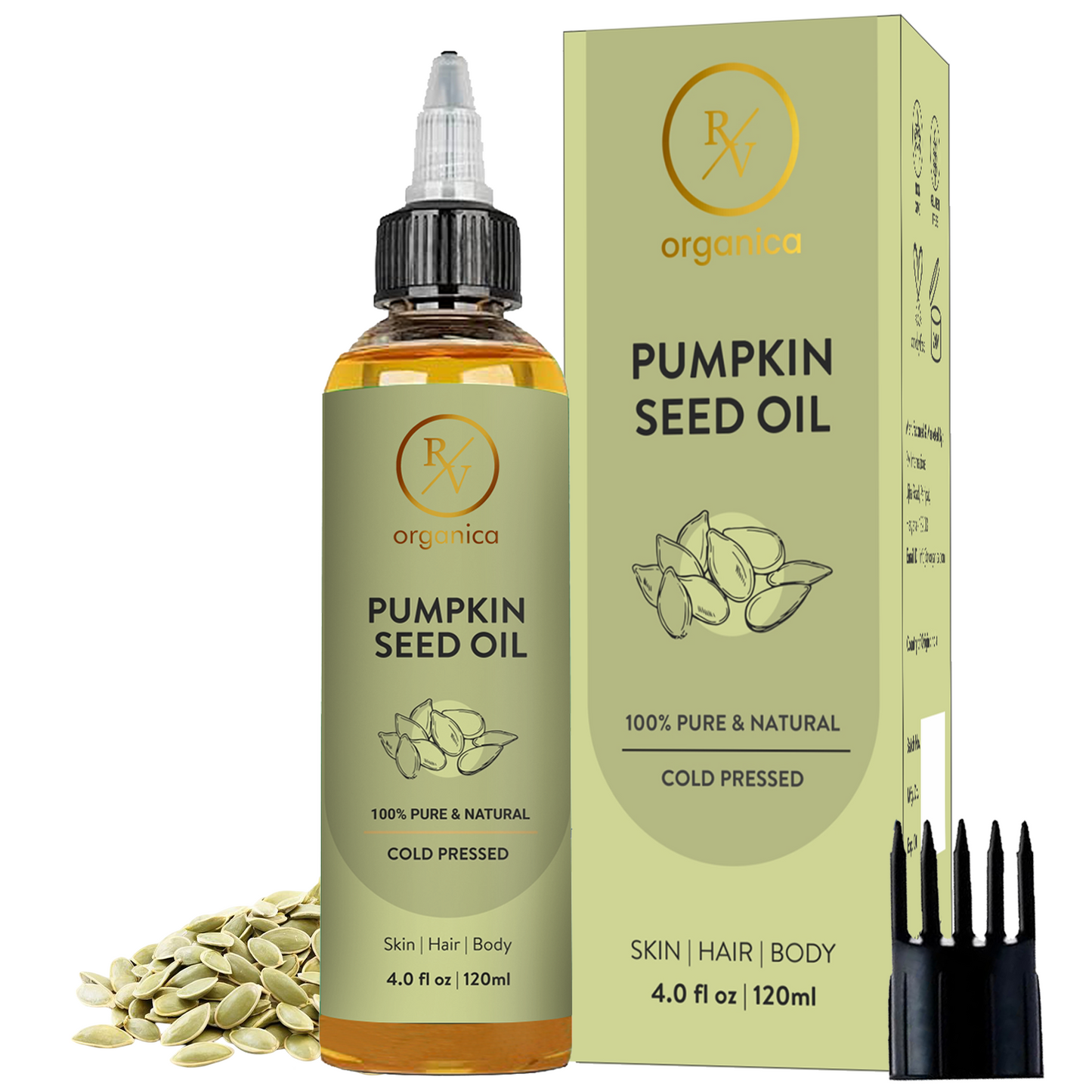


Pumpkin seed oil is cold pressed from the seeds of the pumpkin, a carrier oil valued for its balanced fatty acid content and a distinctive nutrient profile that includes zinc and phytosterols alongside the fatty acids common to most carrier oils. RV Organica's Pumpkin Seed Oil is 100% pure and natural, cold pressed, and supplied in a 120ml (4.0 fl oz) bottle formulated for skin, hair, and body use.
Pumpkin seed oil carries a roughly even mix of linoleic and oleic fatty acids, which puts it in a similar functional category to argan oil, absorbing reasonably well without feeling heavy while still offering enough richness for drier skin and hair. What sets it apart from most other carrier oils in this range is its zinc content, a mineral studied for its role in scalp health and, separately, in skin barrier support, along with phytosterols that contribute to its use in hair and scalp-focused formulations specifically.
The oil's deep green color, visible even through amber glass packaging, comes from its chlorophyll content, a natural byproduct of cold pressing pumpkin seeds without the heat or solvent processing that strips pigment and other compounds from more refined oils. This coloring is a reasonable practical indicator of an unrefined, cold pressed product rather than a diluted or heat-processed version.
For facial and body skin, pumpkin seed oil works well applied to slightly damp skin, either alone or layered under a moisturizer, and its balanced fatty acid profile means it suits a wider range of skin types than oils skewed heavily toward either linoleic or oleic acid alone. It's frequently included in formulations targeting mature or environmentally stressed skin, given its combination of essential fatty acids and antioxidant compounds working together rather than any single ingredient carrying the effect.
For hair and scalp, pumpkin seed oil is typically massaged into the scalp specifically to draw on its zinc and phytosterol content, with some traditional and formulation use associating these compounds with supporting a healthier scalp environment, distinct from the hair-shaft coating role that oils like coconut or argan play more directly. Applying it to the scalp and leaving it for 30 minutes to an hour before washing is a standard approach, similar to other scalp-focused treatment oils rather than a leave-in product.
For general body use, pumpkin seed oil applies well as an everyday moisturizing oil, particularly on drier areas, though its stronger, more distinctive nutty aroma compared to lighter oils like jojoba or grapeseed means some users prefer blending it into a lighter carrier for daily all-over use rather than applying it undiluted across large areas.
Genuine cold pressed pumpkin seed oil has a deep green to dark green color and a robust, nutty, almost roasted aroma, both linked directly to its chlorophyll and fatty acid content. Oil that appears pale yellow or has little to no scent has typically been refined or diluted, which reduces both the visual and functional markers that make pumpkin seed oil distinct from more generic carrier oils in the first place.
A COA (Certificate of Analysis) confirming fatty acid composition and purity is the most reliable verification method beyond color and scent, particularly relevant for pumpkin seed oil given how easily its distinct green color could be approximated with additives in a lower-quality product. Buyers formulating their own hair or skin products, or sourcing in bulk, should request this documentation directly rather than relying on label claims alone.
Pumpkin seed oil's balanced fatty acid profile makes it moderately stable, more resistant to oxidation than highly linoleic oils like rosehip, but still requiring protection from heat and direct sunlight to preserve its color and nutrient content over time. In Indian conditions, particularly through the hotter months from March through October, keeping the bottle in a cool, dark space rather than a sunlit area extends its usable life meaningfully. A shift toward a duller, more brownish tone or a sharper, less nutty smell than usual signals the oil has started to oxidize and is past its effective window.
RV Organica's Pumpkin Seed Oil is 100% pure, natural, and cold pressed, supplied in a 120ml (4.0 fl oz) bottle for skin, hair, and body use. The product is manufactured at RV Organica's facility in Nimbri, Panipat, Haryana, with COA and MSDS documentation available on request, and sits within RV Organica's broader carrier and massage oils collection.
Why does pumpkin seed oil have such a deep green color? The color comes from chlorophyll retained during cold pressing, since the process doesn't involve the heat or solvent treatment that strips pigment from more refined oils. A pale yellow or colorless pumpkin seed oil has typically been refined or diluted.
Is pumpkin seed oil good for hair and scalp specifically, not just skin? Yes. Its zinc and phytosterol content is linked to scalp health support, and it's commonly massaged into the scalp and left for 30 minutes to an hour before washing, functioning more as a scalp treatment than a hair-shaft coating oil.
How does pumpkin seed oil compare to argan oil for skin use? Both carry a roughly balanced linoleic-to-oleic fatty acid ratio, making them suitable across a wide range of skin types, though pumpkin seed oil has a stronger, more distinctive nutty aroma and additional zinc content that argan oil doesn't carry in the same concentration.
Can pumpkin seed oil be used undiluted across the whole body? It can, but its robust, nutty scent is stronger than lighter oils like jojoba or grapeseed, so many users prefer blending it into a lighter carrier oil for daily all-over body use rather than applying it undiluted across large areas.
How should pumpkin seed oil be stored to prevent it from going rancid? In a cool, dark space away from direct heat and sunlight, particularly during hotter months in Indian climates. A duller, more brownish color or a sharper smell than its usual nutty aroma signals the oil has started to oxidize.


| Product Name | Pumpkin Seed Oil for Hair Growth – Cold Pressed |
|---|---|
| Botanical Name | Cucurbita pepo (Pumpkin / Kaddu) |
| CAS No | 85085-52-5 |
| Country of Origin | India |
| F.E.M.A # | Not Applicable |
| Specific Gravity | 0.924 g/ml |
| Moisture Content | ≤ 0.1% |
| Refractive Index | 1.472 |
| Flash Point | > 220°C |
| Acid Value | ≤ 3.0 mg KOH/g |
| Relative Density | 0.924 g/ml @ 25°C |
| Form | Liquid |
| Consistency | Thin |
| Shelf Life | 1 Year (Refrigerate After Opening) |
| Packaging Type | As Per Requirement |
| Extraction or Processing Method | Cold Pressed from Cucurbita pepo Seeds (Pumpkin Seeds) |
| Solubility | Soluble in Carrier Oils & Mineral Oil; Not Soluble in Water |
| Color & Odor | Deep Green to Dark Amber, Clear Liquid; Rich Earthy-Nutty Pumpkin Seed Aroma with Slightly Roasted, Green-Woody Undertone |
| Major Constituents | Linoleic Acid (Omega-6) ~50%, Oleic Acid ~28%, Palmitic Acid ~13%, Beta-Sitosterol, Cucurbitacins, Zinc |
| Blends With | Jojoba Oil, Rosemary EO, Peppermint EO, Tea Tree EO, Argan Oil; Especially Suited for Scalp & Hair Growth Blends |

