


Mithaas Gift Set for Her
Rs. 2,889.00Rs. 5,999.00New Launch
🛍️ Add products to unlock free delivery!
Your bag is empty
Continue Shopping100% Pure Cold Pressed from Morocco | Rich in Oleic Acid (43–50%) & Linoleic Acid | Anti-Frizz & Liquid Gold Shine Formula | For Dry, Damaged & Color-Treated Hair
Need large quantity? Contact us for bulk orders →
Couldn't load pickup availability

Moroccan Argan Oil for Frizz-Free Shine – Cold Pressed
Rs. 349.00

Rosemary + Vitamin E + Tea Tree — Hair Growth & Care Combo
Rs. 999.00

Rosemary Ricewater Hair Spray
Rs. 249.00

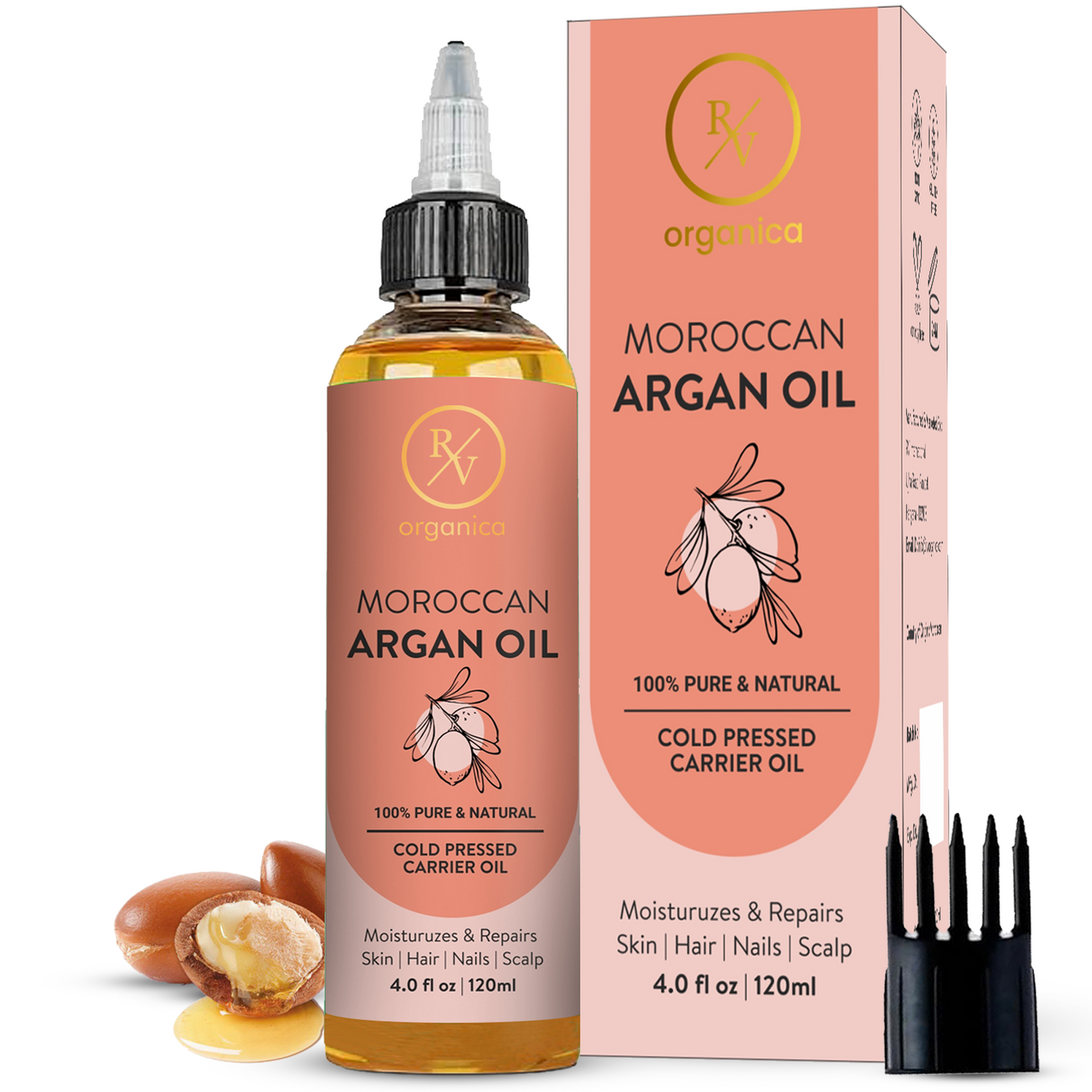


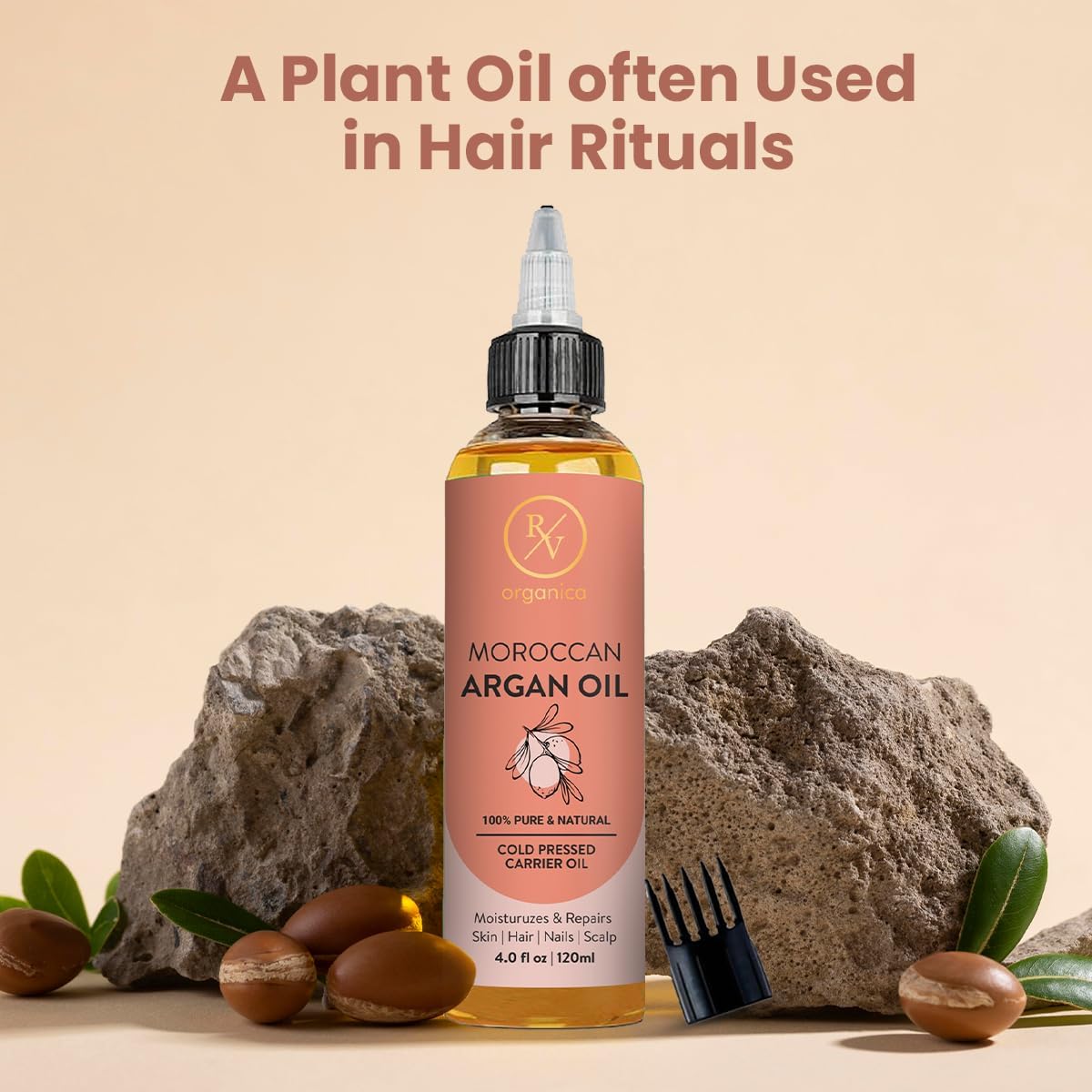


Moroccan argan oil is cold pressed from the kernels of the argan tree, native to southwestern Morocco, and is used as a carrier oil across skin, hair, nail, and scalp care. RV Organica's Argan Oil is 100% pure and natural, cold pressed, and supplied in a 120ml (4.0 fl oz) bottle formulated to moisturize and repair across multiple applications.
Argan oil sits in a middle range on the linoleic-to-oleic fatty acid spectrum, roughly 36% linoleic to 45% oleic acid, which is a large part of why it works across such a wide range of applications. Oils skewed heavily toward linoleic acid, like rosehip or grapeseed, tend to suit oily or acne-prone skin better, while oils skewed toward oleic acid, like olive or coconut, suit drier skin and hair better but can feel heavier. Argan oil's balanced ratio means it absorbs reasonably quickly without feeling as heavy as a purely oleic-dominant oil, while still offering enough richness to work on drier skin and hair types.
Argan oil also carries a notably high concentration of vitamin E tocopherols compared to many other carrier oils, which functions as a surface-level antioxidant and contributes to its use in anti-aging and skin-repair positioning. Cold pressed extraction, done without heat or solvents, preserves these tocopherols more effectively than heat-processed or refined argan oil, which is one reason cold pressed variants are generally positioned as the higher-quality option in formulation and retail.
For facial and body skin, a few drops of argan oil work well applied to slightly damp skin, either alone or layered under a moisturizer, since the balanced fatty acid profile allows it to absorb without leaving an overly greasy finish on most skin types. It's commonly used on drier areas of the body, and for facial use, moderate application rather than heavy layering avoids the oil sitting on the skin's surface without absorbing.
For hair, argan oil is typically applied to the mid-lengths and ends rather than the scalp, smoothing the hair cuticle and reducing frizz without weighing hair down the way heavier oils can. Some routines also use a small amount at the scalp specifically to address dryness or flaking, though heavier daily scalp application isn't necessary for most hair types and can lead to product buildup over time if overused.
For nails and cuticles, argan oil is massaged directly into the nail bed to address dryness and brittleness, drawing on the same moisturizing fatty acid content that benefits skin. It's a common addition to nail care routines specifically because its lighter texture, relative to oils like castor, absorbs without leaving a heavy residue on the hands.
Authentic cold pressed argan oil has a distinctive, slightly nutty aroma and a golden-amber color, and it's genuinely more expensive to produce than heat-processed or refined versions, since Moroccan argan kernel extraction is a labor-intensive process. Argan oil priced significantly below market rate for its stated volume is worth questioning, since it's more likely to be diluted, refined, or blended with a cheaper carrier oil rather than being the pure cold pressed product the label claims.
A COA (Certificate of Analysis) confirming the oil's fatty acid composition and purity is the most reliable way to verify quality beyond scent and color alone, particularly for buyers formulating their own products or sourcing in bulk rather than purchasing a single retail bottle for personal use.
Argan oil is more stable than some lighter carrier oils like rosehip, but it still benefits from being stored away from direct heat and sunlight to preserve its vitamin E content and prevent oxidation over time. In Indian conditions, particularly during the hotter months from March through October, keeping the bottle away from windowsills or direct warmth extends its usable life meaningfully beyond what the printed shelf life assumes under ideal storage. A change toward a duller color or a sharper, less nutty smell than usual signals the oil has started to oxidize and is past its effective window for skin or hair use.
RV Organica's Moroccan Argan Oil is 100% pure, natural, and cold pressed, supplied in a 120ml (4.0 fl oz) bottle for skin, hair, nail, and scalp use. The product is manufactured at RV Organica's facility in Nimbri, Panipat, Haryana, with COA and MSDS documentation available on request, and sits within RV Organica's broader carrier and massage oils collection.
What's the difference between cold pressed and refined argan oil? Cold pressing extracts the oil without heat or solvents, preserving vitamin E tocopherols and other compounds that get degraded during standard heat-and-solvent refining. Refined argan oil is typically more neutral in scent and color but carries less of the antioxidant content associated with the unrefined version.
Can argan oil be used on the scalp as well as the hair length? Yes, in smaller amounts to address dryness or flaking, though most routines focus application on the mid-lengths and ends of hair rather than the scalp, since heavier daily scalp use isn't necessary for most hair types and can lead to buildup over time.
Is argan oil suitable for oily or acne-prone skin? Argan oil sits in a balanced middle range between linoleic and oleic acid, so it works reasonably well across skin types, but very oily or acne-prone skin may find lighter, more linoleic-dominant oils like rosehip or grapeseed absorb faster with less risk of feeling heavy.
How can you tell if argan oil is genuinely cold pressed and pure? A distinctive nutty aroma and golden-amber color are practical indicators, along with pricing that reflects the labor-intensive extraction process, since significantly underpriced argan oil is more likely diluted or blended. A COA confirming fatty acid composition is the most reliable verification for bulk or formulation buyers.
How should argan oil be stored to prevent it from going rancid? Away from direct heat and sunlight, particularly during hotter months in Indian climates, since both accelerate oxidation and reduce the oil's vitamin E content over time. A duller color or a sharper smell than the oil's usual nutty scent signals it has started to oxidize.


| Product Name | Moroccan Argan Oil for Frizz-Free Shine – Cold Pressed |
|---|---|
| Botanical Name | Argania spinosa (L.) Skeels (Argan Tree) |
| CAS No | 223747-87-3 |
| Country of Origin | Morocco (Agadir Region) |
| F.E.M.A # | N/A |
| Specific Gravity | 0.908 – 0.918 g/ml @ 20°C |
| Moisture Content | NMT 1.0% |
| Refractive Index | 1.467 – 1.480 @ 20°C |
| Flash Point | >200°C (392°F) |
| Acid Value | NMT 1.0 mg KOH/g |
| Relative Density | 0.908 – 0.918 |
| Form | Liquid |
| Consistency | Thin to Medium Liquid (non-greasy, fast-absorbing) |
| Shelf Life | 2 Years from Manufacturing Date |
| Packaging Type | Amber Glass Bottles / HDPE Bottles / HDPE Drums |
| Extraction or Processing Method | Cold Pressed (from kernels of Argania spinosa fruit) |
| Solubility | Insoluble in water; soluble in cosmetic esters and fixed oils |
| Color & Odor | Clear to light golden-yellow liquid; mild, characteristic nutty odor |
| Major Constituents | Oleic Acid (43–50%), Linoleic Acid (29–37%), Palmitic Acid (10–15%), Stearic Acid (4–7%), Tocopherols (Vitamin E), Polyphenols, Phytosterols |
| Blends With | Rosehip Oil, Jojoba Oil, Vitamin E Oil, Castor Oil, Lavender EO, Geranium EO, Ylang-Ylang EO |

